What to Do During a Police Check in a Rental Car
A police check is a completely normal roadside situation and should not cause you concern. If you drive calmly, follow the police officers' instructions, and carry the required documents, a traffic police check usually wraps up quickly.
When driving a rental car, there is one key feature: besides your personal documents, it is extremely important to know where the vehicle's documents and the rental agreement itself are located.
In this practical guide, we will look at how a standard roadside check proceeds and what you should keep in mind when driving a rented vehicle.
When and How You Should Stop When Signaled by Traffic Police
When signaled to stop by traffic police officers (via a signal wand, hand gesture, light, or sound signal), the driver is required to pull over smoothly on the rightmost part of the roadway or at the spot indicated by the officer. These steps are outlined in the Bulgarian Road Traffic Act.
The most important behavioral rules at this moment are:
No sudden maneuvers: Reduce speed smoothly and pull over safely.
Do not continue driving: Attempts to stop further down the road under the pretext of finding a more convenient spot can be interpreted as an attempt to flee.
Stay inside the vehicle unless instructed otherwise by the officer: stay inside the vehicle unless instructed otherwise – turn on your hazard lights, keep calm, and wait for the officer to approach.
Keep your hands in plain sight: Avoid hastily searching the glove compartment or your personal luggage before the officer reaches your window and asks for your documents.
This behavior ensures that the check proceeds quickly, professionally, and without unnecessary tension.
What Documents You Are Required to Carry
By law, every driver of a motor vehicle in Bulgaria is required to carry the following basic minimum:
A driving license for the relevant category.
The vehicle registration certificate, known as the "small coupon" (small registration card).
For foreign drivers: Control authorities check a valid identity document, such as a passport or ID card, as well as a driving license recognized in Bulgaria. In certain cases, an International Driving Permit may also be required. You will find more information in our detailed guide on rules for foreign drivers in Bulgaria.
Specific Documents for a Rental Car
When traveling in a rented vehicle, it is good practice to have the rental agreement or a copy of it (as well as booking details). While police may not ask for it every time, carrying a copy of your agreement is the quickest way to prove you are authorized to drive the car and avoids unnecessary questioning.
If you rented a car from DL Rent, a good practice is to ask the staff member exactly where the car's documents are stored and what the packet includes. This will save you the stress of searching at the last minute. It is also recommended to save the rental company's phone number in your mobile phone for quick contact.
You do not need to carry paper proof of a vignette, as vignettes in Bulgaria are entirely electronic; there is no need to keep or present a paper document or receipt. Verification of a valid e-vignette is performed electronically by enforcement authorities.
How a Standard Roadside Police Check Works
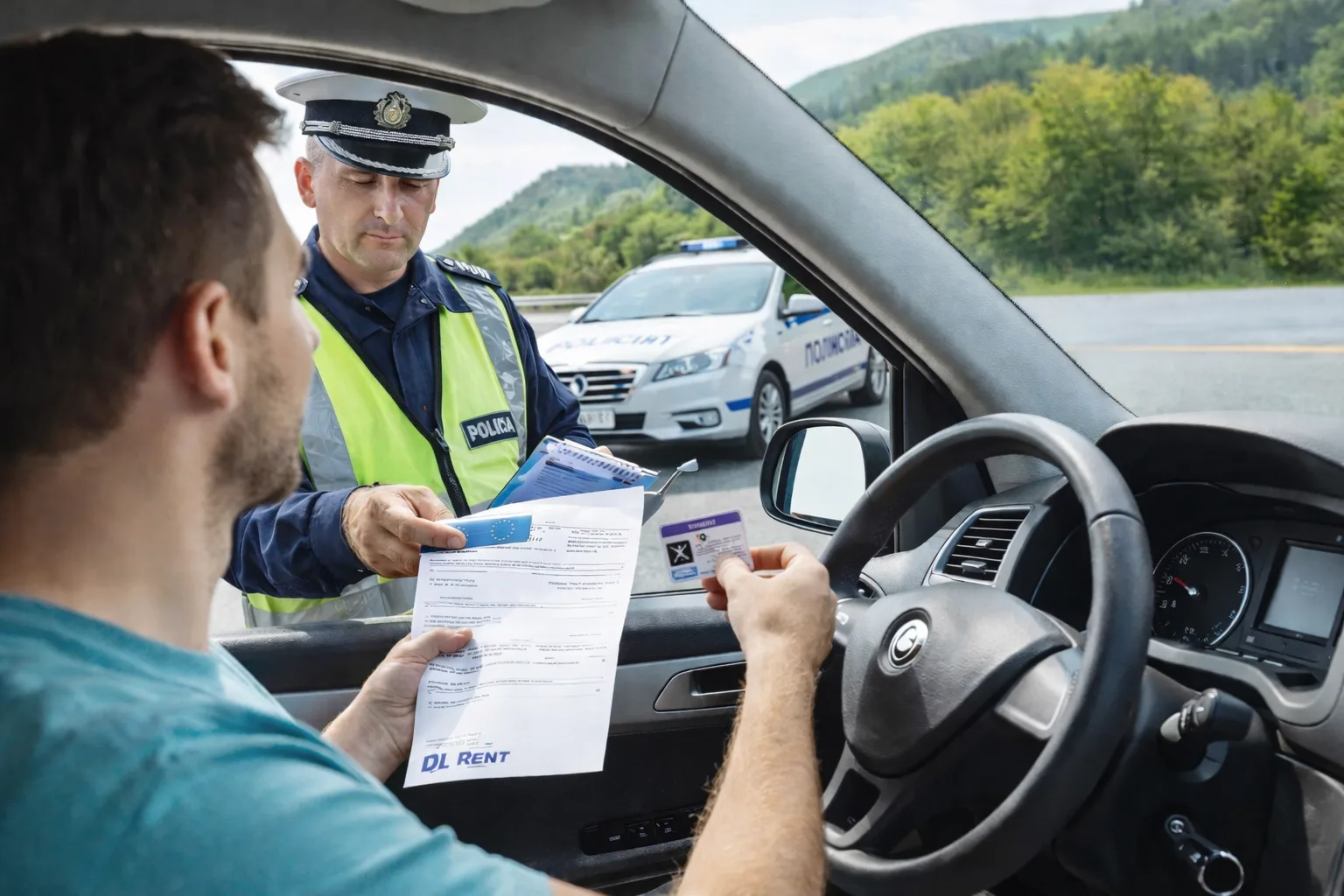
In a routine situation, the law enforcement officer introduces themselves, states the reason for the stop, and requests the driver's and vehicle's documents. The control authorities verify their validity, Third-Party Liability insurance, and whether there are any unpaid fines.
When driving a rental car, it is completely normal to be asked questions such as: "Where are you traveling to?", "Whose car is this?", or "Is it yours?". The best approach is to answer briefly, accurately, and in a calm tone: explain that the car is rented, state the rental company, and reassure the officer that all documents are in order. Do not get into arguments.
Alcohol and Drug Testing
Bulgarian law imposes strict limits and severe penalties for driving under the influence of alcohol or drugs. On-site alcohol testing is conducted using a breathalyzer, and drug testing is done using a specialized field test (in accordance with Ordinance No. 1 of July 19, 2017 on the procedure for establishing alcohol and/or drug use).
Legal Penalties
Penalties are regulated under Article 174 of the Road Traffic Act:
Blood alcohol concentration from 0.05% to 0.08% (0.5 to 0.8 g/L): Results in a 6-month driving license suspension and a fine of BGN 500 (approximately EUR 256).
Blood alcohol concentration from 0.08% to 0.12% (0.8 to 1.2 g/L): Results in a 12-month driving license suspension and a fine of BGN 1,000 (approximately EUR 511).
BAC above 0.12% (1.2 g/L) or drug consumption: Treated as a criminal offense under Article 343b of the Penal Code.
Note: For a blood alcohol concentration above 1.2 per mille, or when driving after consuming drugs or their analogs is established according to due process, criminal liability applies under Article 343b of the Penal Code. In these cases, harsher penalties and measures may be imposed.
Important: Refusing a test is not a solution! Under the law, if you refuse an alcohol/drug breathalyzer or field test or fail to comply with a medical examination order, a severe administrative penalty follows: a 2-year license suspension and a fine of BGN 2,000 (approximately EUR 1,023). Comply with the lawful orders and instructions of control authorities.
Keep in mind that if the result of the field test is disputed, the procedure may continue with a laboratory blood test at a medical facility.
What NOT to Do During a Traffic Police Check
To ensure the check passes as quickly as possible, avoid the following mistakes:
Do not argue aggressively or raise your voice: This will only prolong the process and prompt additional detailed checks.
Do not make sudden movements: Do not reach into the glove compartment, under seats, or into your pockets before the officer explicitly requests your documents.
Do not sign documents mechanically: If an official citation or offense report (known locally as an AUAN) is issued, read it carefully. Check that the date, location, circumstances, and your personal details are written correctly. If you disagree with the findings, you have the right to write your disagreement in the explanation field or submit additional written objections within 7 days of signing.
Critical Step When Driving a Rental Car
If during the check an offense report is written, documents are confiscated, the Vehicle registration card (commonly known as the 'small coupon' in Bulgaria) is retained, or any other administrative issue arises, notify your rental company immediately. Do not wait until the return date of the vehicle to report it. For the lessor, this is crucial information, as the vehicle is their asset. Some penalties and police actions can affect the validity of registration documents, insurance procedures (Casco/Third-Party Liability), or disrupt subsequent vehicle bookings.
Conclusion
With an owned vehicle, the driver knows its history and where every necessary document is, whereas with a rented vehicle, a little more attention is required from the very start. Check all documents at the company's office, save the support phone number, and follow traffic rules. This will ensure a calmer, safer, and trouble-free trip.
*The provided information is general in nature and does not constitute legal advice.
Frequently Asked Questions
Do traffic police accept a digital rental agreement on my phone, or do I need a paper copy?
The law requires physical identity and vehicle registration documents ("small coupon") to be presented. Since the rental agreement serves to prove the legal basis on which you are using the car, in most cases law enforcement officers also accept a digital copy on your phone screen. For complete peace of mind and to avoid delays, it is recommended to keep a paper copy in the car.
What Happens If the Police Remove the License Plates of the Rental Car Due to My Violation?
This is a serious situation. You must notify your car rental company immediately. Having your license plates removed officially revokes the vehicle's registration. Because the violation was committed by the driver, all associated fines, impound fees, and administrative costs will be charged to the renter.
About the Author
Gergana Ivanova – Category B Driving Instructor & Co-founder of DL Rent.
With extensive experience in driver training and fleet management, Gergana ensures that DL Rent customers receive transparent service, impeccably maintained cars, and complete peace of mind behind the wheel.